Categories
Blog

Article Release: Number Talks and Multilingual Learners

I used to think that if I randomly called on students it would be fair, discussions would be rich, and everyone’s ideas would be honored.  Then I met the class of introverts. Three-fourths of them were boys – sixth graders – and I couldn’t get any kind of discussion started. And cold-calling made it worse. In fact, cold-calling generates compliance, not learning, and it is especially harmful for multilingual students who often benefit from time to talk through their ideas with a trusted friend before sharing with the whole class. 

My class of introverts inspired a quest – how could I create the conditions in math class that would invite rather than compel students to share their ideas? It started with dumping the cold call practice.  When I told the class of introverts I would quit the cold calls, they cheered. That made a huge difference, especially the next year when I started fresh with a new group of students. They knew from the start they could trust me not to put them on the spot. Adam began raising his hand in April of that year. He told me in the last weeks of school, “This is the first time I have ever spoken up in math class. It’s because I am not scared you are going to call on me.”

Eventually, I met Heather and Maribel, accomplished language acquisition teachers.  I figured if anyone could help me figure out how to support students to share their ideas, it would be teachers who had spent their career thinking about language development. We worked together for a school year on the Number Talk routine, looking for ways to adjust and adapt it to invite the voices of multilingual students to the center of our classrooms.

This article, appearing in the September issue of NCTM’s Mathematics Teacher: Learning and Teaching is the result of our work together. Enjoy!

MTLT_Number Talks and Multilingual Learners

Or maybe you prefer a podcast.

Check out our May 7 episode at Rounding Up from the Math Learning Center

Categories
Blog

Have you ever been overwhelmed as a teacher?

Silly question, right? Who hasn’t?

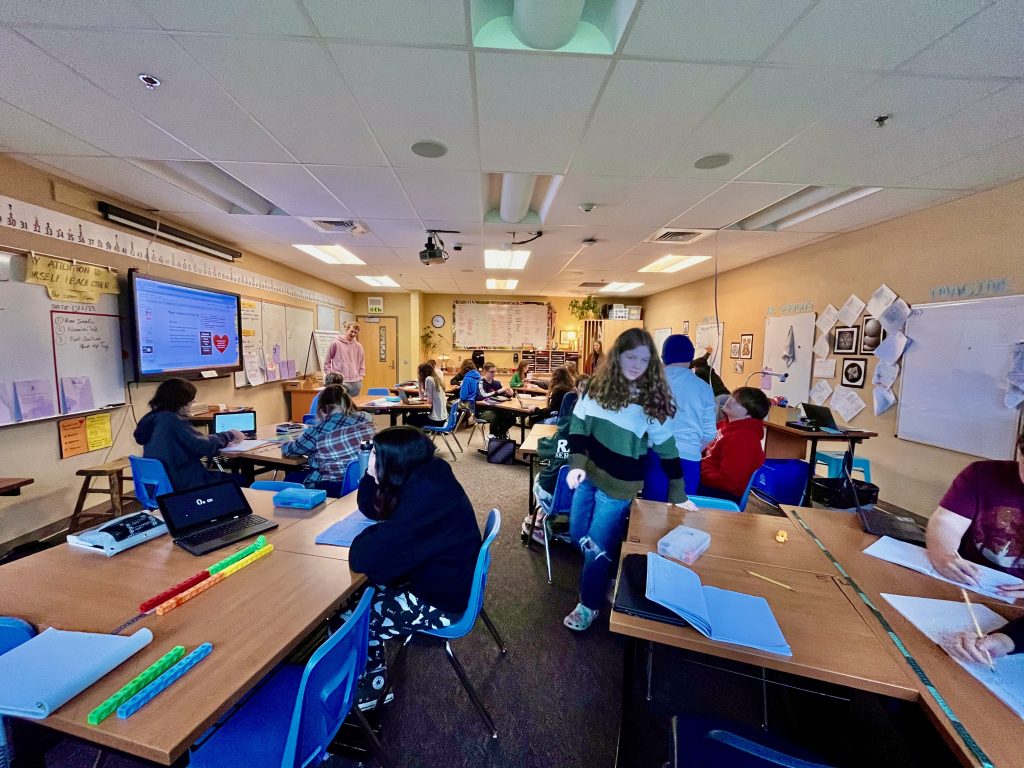
At some point I realized I could manage about nine conversations at a time, not thirty-five.  I had large classes in a small town middle school. And I just couldn’t keep up with tracking the ideas of thirty-five students in real time all at once. But when I put them in groups of four, I could circulate and follow the story at each table. My overwhelm decreased, and teaching became as manageable as a wait section in a restaurant on a Saturday night. I could circulate and attend to the learning at nine tables rather than scurrying from person to person, providing help and redirecting. 

Collaborative learning doesn’t “just happen.” I had to convince students that they’d benefit from working together.  Lucky for me, a teacher down the hall taught me about “Desk Olympics” which provided a competition between classes for which class could form groups of four the fastest.  By the time groups had managed to move their tables together, they were interdependent.  In a small way they knew they had people they could count on.
Desk Olympics went a long way towards expanding students’ ideas of who they wanted to work with. Moving desks interrupted status dynamics established by other school activities. Often the most thoughtful desk mover got to show their problem solving prowess in ways that paper and pencil had obscured.  

Later, I learned to have students interview each other every time they got new seats.  The better they knew one another, the more they could support each other. That way, I could manage nine tables with creative efficiency rather than endure the overwhelm of so many minds and bodies and brain hijack that came with it.

Categories
Blog

Digits. Fingers. Hands-on. Manipulatives.

There’s a reason we keep track of quantities on our fingers.  Our digits, always ready, map the correspondence between things and numbers.  I remember, as a very young child, watching telephone poles and row crops fly by outside the rear window of the car.  As they passed, I counted, keeping track on my fingers. I matched object to digit to number and found patterns in groups of three, four and five.  When the grouping went to six, both hands came into play.  Long before anyone told me not to do math on my fingers, I was connecting the world I saw to numbers through my body. 

Manipulatives – from the Latin root Mano which means hand – build a foundation for understanding mathematical concepts in more abstract ways. And it’s never too late to map what we see with our hands. 

In a recent workshop for high school teachers, participants used manipulatives to explore transformations of functions.  They built a pattern of increasing squares with little square tiles. They built the pattern and then rebuilt it using transformations that would shift the graph of the pattern up, down, right and left. They built what it meant to narrow the squares, double them and divide them in half. By using their hands, they made core concepts in algebra visible. 

Everything those teachers did, they could have done just using symbols – that is, digits and variables with procedures drawn from memory. As they worked, digits and variables came into play, as a meaning-making extension of what they did with their hands. 

Counting on and with our fingers is not just for young children in the back seat of the car. For those new to working with the symbols of algebra, manipulatives fill the gap between what learners can see and understand, and what they are in the process of learning. Manipulatives matter in learning mathematics, no matter how old your students are.

Categories
Blog

Have you ever had hands-on math feel fun, but fade fast?

Most learners like it when they can do something novel, but hands-on learning has to develop mathematical understanding for students to stay engaged. That is, concrete materials have to allow students to grapple with mathematical ideas they are in the process of developing. When that happens by design, students’ thinking becomes visible to each other and to their teacher.  When students can see each others’ thinking, community develops, and when hands-on materials make it easy for teachers to see student ideas, being flexible and responsive to developing thinking becomes second nature.

High school teachers recently began a five-day workshop designed to deepen their understanding of functions with a lab involving water and vases.  Their task was to predict the graph of the height of the water in a given vase as they added increments of water, and then test their prediction.

This hands-on math got the workshop off to a very strong start. Everyone, no matter their background, understood water and vases, or measuring, or graphing. No one could accomplish the task alone. Someone had to measure, someone had to fill and another person had to record.  Soon the multi-dimensional nature of the task itself got people talking and laughing and helping each other and puzzling over results.

But more than that, the task’s focus on the relationship between an input and an output, landed participants in the center of grappling with ideas essential to understanding functions. Nearly everyone’s predictions improved as they repeated the task with vases of differing shapes, and issues of accuracy, rates of changes, and the relationship between independent and dependent variables became rich sources of conversation.

In fact, hands-on math can make visible the relationships between quantities, through relationships between people.  This is at the heart of powerful mathematics teaching and learning. Once teachers get a taste of it, they want more.